Every 1L learns a doctrine that feels, on first contact, like a glitch in the law: Adverse Possession.
A squatter sits on your land long enough.. openly, without permission… and one day the law simply hands the squatter the deed.
You, the original owner did nothing wrong. You just did… nothing. And in property law, doing nothing for long enough means forfeiting ownership rights that you once had.
It struck me as outrageous when I learned it in law school. It strikes me now as the most honest description of inflation I know.
The elements of Adverse Possession applied
The doctrine is common law, codified differently in every state, and a squatter has to satisfy real elements before title passes.
A typical statute requires that the possession be open and notorious, exclusive, hostile — meaning without the owner’s permission — and continuous for a prescribed statutory period, which runs from as little as three years in some states to twenty in others. Some states make you pay the property taxes the entire time.
The rules vary. The principle does not. Adverse possession rewards putting land to productive use and punishes the owner who sleeps on his rights — neglect a thing long enough while someone else quietly uses it, and ownership changes hands.
Now look at the cash sitting in your account, and run the elements that matter.
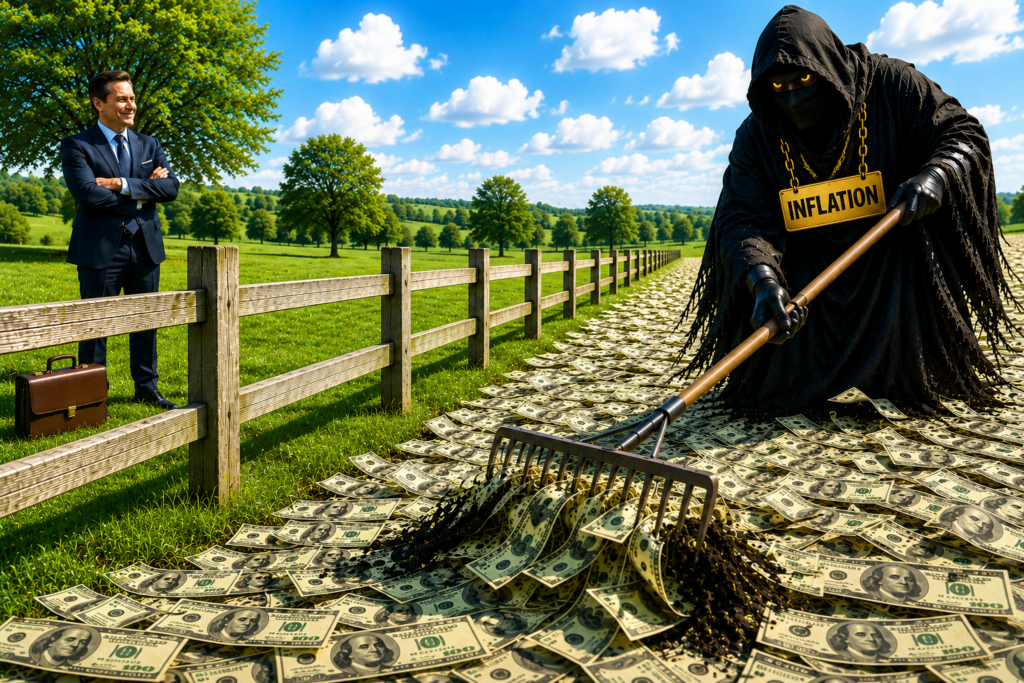
Hostile, without permission… Inflation has never once asked whether you approve. It does not need your consent, your signature, or your vote. It simply takes.
Open and notorious… Inflation is not hiding. It is posted in plain view — the grocery receipt, the tuition bill, the price of the same flight that cost half as much a decade ago.
Continuous, for the statutory period. This is the part that should frighten a careful person. Inflation doesn’t take a year off. It is a slow-moving financial zombie, compounding against your purchasing power the way your investments are supposed to compound for you — quietly, relentlessly, in the background. At a mild 3% a year, the dollar in your checking account loses half its purchasing power in about 24 years. Give it the length of a career, or a retirement, and the claim does not merely accrue. It ripens. Title passes.
The careful lawyer’s mistake
Here is what lawyers get backwards, in exactly the way the careless landowner does.
For a conservative lawyer, it may seem that the safest, most prudent thing to do with money is to protect principal. And cash does this better than anything else. Keep $10,000 in a safe deposit box, and the same $10,000 will be there tomorrow. And the day after that. And the day after that…
The problem is that the only reason cash has value is that you can buy things with it. If the same $10,000 buys less in the future, you have lost purchasing power — and purchasing power is the thing that actually matters. Who cares that you preserved the principal if the one thing you wanted the money for, to spend it, can no longer be done?
So the move that looks safe — responsible, do-nothing-rash, sit-tight — is the one that quietly loses the land.
The owner who never enters his property, never improves it, never ejects the trespasser is the one the doctrine punishes. Passivity is not neutral. Passivity is the mechanism of the loss.
Idle cash is that abandoned parcel. And inflation is the most patient of squatters.
How you defend the parcel
So how does a true owner defeat an adverse possession claim? Not by complaining about the squatter. By possessing his own land — using it, improving it, putting it to work, making his ownership unmistakable and continuous.
The defense against inflation is the same. You put the money to work. You own productive assets — businesses, through equities — that have historically grown faster than the squatter (inflation) can encroach. Companies raise their prices, earnings, and dividends in the very same inflationary tide that erodes idle cash, and ownership of them has, historically, outpaced inflation over long horizons. That is what defending the parcel looks like on a balance sheet. Holding cash is not avoiding risk. It is abandoning the property and hoping the squatter is slow and doesn’t take too much.
None of this means hold no cash. You need a reserve you can reach tomorrow without flinching — an emergency fund, the next year or two of real expenses. That is the part of the property you are actively living on.
But the surplus you let sit untouched, year after year, “to be safe”? That is not safety. That is an open invitation, posted on the gate, in a doctrine you already know by heart.
Don’t let the clock run
Adverse possession can offend our sense of fairness because it rewards the wrong virtues: patience in the squatter, and neglect in the owner.
Inflation runs on the identical logic. So go look at your own land. Add up the cash that has been sitting “to be safe” for more than a year or two, decide what truly belongs in the reserve you live on, and put the rest to work before the clock runs any further. The doctrine you learned in your first year of law school has been quietly trying to teach you this all along.
Don’t let the clock run on your land, or your balance sheet.
Illustrations are provided for educational purposes only and are not intended as investment advice. Every investor’s financial situation, goals, and risk tolerance are unique. You should consult qualified financial, tax, and legal professionals regarding your specific circumstances.