A client wrote to me last week — a careful, smart lawyer, the kind who reads the fine print, because reading the fine print is the job.
He’d mostly made his peace with staying invested. But one thing was gnawing at him:
“My concern is that Iran holds all the cards when it comes to oil. They have zero incentive to keep the price at $80–100. If they want to disrupt the global economy — and by extension ours — they can.”
He’s not wrong.
Let me say that again, because you’re expecting me to argue with him, and I’m not going to. He might be completely right. Oil could go to $150. It could go to $250. Iran may well have both the means and the motive.
And it doesn’t matter.
Not because the risk isn’t real — but because it’s the wrong altitude. He’s standing six inches from the canvas, staring at a single brushstroke. I want to step him back until he can see the whole painting.
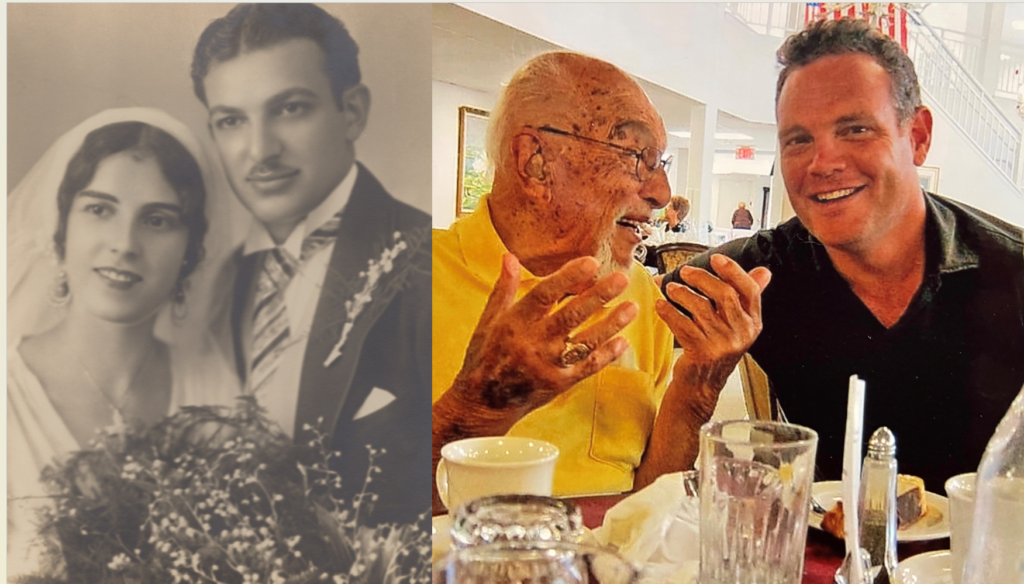
My Grandfather, Guido Salvatore Corriero
My grandfather, Guido Salvatore Corriero, was born in 1909 in New York to Sicilian immigrants and lived to 105 years old.
Because he lived so long, I got to know him as an adult — really know him — and I remember the strange vertigo of listening to him talk.
He could remember the iceman.

Source: Library of Congress
A man with a horse-drawn wagon would haul a block of ice up the stairs of his tenement and load it into the icebox, because there was no refrigerator, because there was barely electricity. When Guido was a boy, the horse was not nostalgia. The horse was transportation.
The year he was born, the Wright brothers’ great achievement was six years old — a contraption that had flown, on its first hop, for twelve seconds and a hundred and twenty feet.
That is shorter than the wingspan of the 747 you’d now board without a second thought. A glorified kite with a motor.
By the time my grandfather died, a nonstop flight from New York to Tokyo was so unremarkable that the only thing anyone complained about was the legroom.
One life. That entire distance.
And the numbers underneath that life moved just as violently. The year Guido was born, the whole American economy was about thirty-two billion dollars. (1) The whole thing. Today one company — one — is worth more than five trillion. One company is now worth over a hundred times the entire country he was born into.
The mightiest company in America in 1917 was U.S. Steel — the first “billion-dollar company.” Steel and oil and railroads. Things you could touch. The blue chips of Guido’s prime were Kodak and Polaroid, names so solid they were practically synonyms for permanence.
Kodak and Polaroid went bankrupt.
The safest, most obvious, can’t-miss giants of one era became the cautionary tales of the next. Follow that thread for a moment, counselor — because it leads somewhere that matters for your portfolio.
Could anyone have seen it coming?
Could Guido’s generation have imagined the iPhone — a slab of glass in your pocket with more computing power than all of NASA commanded the day it landed a man on the moon? The internet? Artificial intelligence? Quantum computing? Essentially no one could.
That’s the point. The future isn’t just unknown. It is, to almost everyone alive, unimaginable. It always has been.
Now turn the telescope around
If you are in your thirties with young kids, and those kids live into their nineties — which is increasingly likely — then you are looking forward exactly as far as Guido looked back. From the horse-drawn ice wagon to the nonstop transpacific flight. That is the span you are actually investing across.
So let me ask the question this whole thing has been driving toward.
What is my client actually afraid of?
Not oil. Oil is the costume this year’s fear is wearing.
Guido lived through the same fear in a different costume — twice. In 1973, and again in 1979, the experts said precisely what my client is saying now: the oil powers hold all the cards, they can bring the West to its knees, this is the one that breaks us. Gas lines around the block. Rationing by license plate. The Iran hostage crisis on the evening news, night after night.
The world did not end. It never does.
“The only function of economic forecasting is to make astrology look respectable.”
– John Kenneth Galbraith
Nobody can tell you what oil does next — not Iran, not my client, not me.
But a hundred years told Guido the same thing, over and over: the terrifying thing is temporary, and the thing we take for granted — people building, inventing, climbing — is permanent. We get it exactly backwards, every time.
Investing was never a contest of predictions. It is the oldest battle there is: fear of the future against faith in the future. And the historical record on that fight is not close.
So own a piece of the whole thing, and hold it through the costume changes. Because the next one is already being stitched — oil, or a virus, or a war, or a word we don’t have yet — and the only lesson Guido’s century actually taught is the one worth keeping.
The world doesn’t end, even when it looks like it’s about to.

In memory of Guido Salvatore Corriero, 1909-2014