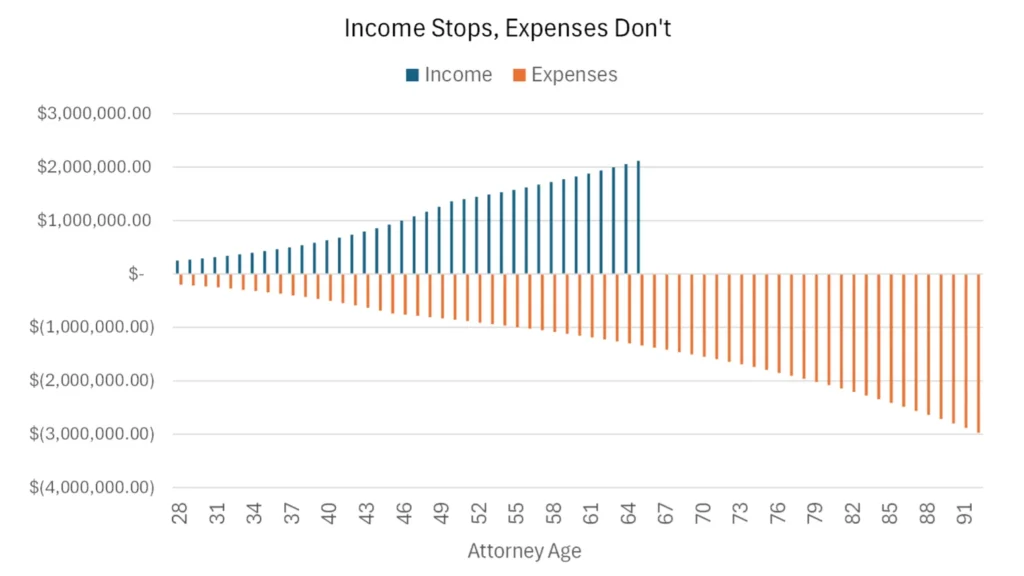
The chart below shows a hypothetical lawyer’s lifetime income and expenses, from age 28 through 92. I’ve made reasonable assumptions: income ramps up over a career, the lawyer retires at 65, and expenses in retirement grow only at the pace of inflation. And I’m not even including end-of-life care.
The blue bars — your income — rise steadily from your late twenties through your peak earning years. They stop at 65. Done. The spigot turns off.
The orange bars — your expenses — never stop. They start the day you begin working and continue for the rest of your life. And in retirement, they grow. Every year. Property taxes go up. Healthcare goes up. The cost of everything goes up. For a quarter century. Maybe longer.
Your earning years are likely to be just a bit more than half of your adult lifetime. In my example, you are funding 65 years of expenses with roughly 37 years of income. Let that sink in.
Here’s the fundamental dynamic: when you practice law, you earn money on your labor. That’s your human capital. The only path to a secure and independent future is to convert it — while you still can — into financial capital. Money that keeps working for you when you no longer can.
Because the spigot turns off. The bills don’t.
The solution to this problem is planning. It does not have to be complicated. In fact, if it can’t be laid out on the back of the proverbial envelope, it’s too complicated.
It’s something like this: to retire at your target age, and spend an inflation-adjusted $X every year for the rest of your life, you should probably have $Y in investments. Given your current age and what you’ve already saved, we can pretty easily figure out how much you have to invest every year to get there.
If you can’t do this yourself, call me.